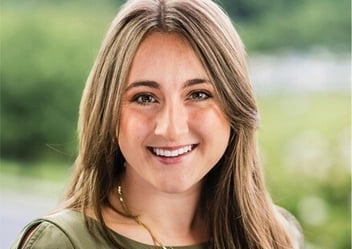
When Annie Benson arrived at Vanderbilt straight from her undergraduate program, she knew she wanted to work at the intersection of engineering and healthcare. What she didn’t know was just how profoundly the Master of Engineering in Surgery and Intervention (MESI) program would reshape her trajectory — or that it would ultimately lead her to pursue a doctorate in computational biophysical modeling right here at Vanderbilt.
Today, Annie is a Ph.D. student in the Vanderbilt Institute for Surgery and Engineering (VISE), continuing the work she began as a master’s student. But her journey started with a simple question: Where can an engineer learn to innovate inside the clinical environment itself?
Discovering a Program Built Around Real Clinical Needs
“MESI was one of the only programs that truly emphasized engineering research in the healthcare space,” Annie recalls. “I loved that the work wasn’t hypothetical. It was driven by real clinical needs, and we were collaborating directly with clinicians.”
Coming straight from undergrad, Annie was looking for a program that would give her both technical depth and authentic exposure to the realities of medical device development. The MESI program’s flexible structure allowed her to tailor her coursework toward surgical robotics and medical device design — while also discovering new interests she hadn’t anticipated.
“I came in wanting to build my technical background,” she says. “But the flexibility of the program also let me explore areas I didn’t even know I wanted, like grant writing and startup culture.”
Immersion in the Clinical World — and the Class That Changed Everything
For Annie, the clinical immersion component wasn’t just a highlight — it was transformative.
She points to the Provocative Questions course as a defining experience.
“It was honestly my favorite class,” she says. “Hearing clinicians from so many specialties talk about the pressing issues in their fields was eye‑opening. Even with all the advances in technology, so many challenges in medical implementation still persist.”
The course didn’t just expose her to problems — it connected her to the people behind them. That connection deepened during hands‑on immersion experiences, from assisting with porcine sample extraction for ex‑vivo experiments to observing cadaver studies led by surgeons she had met in class.
“These experiences made everything real,” she says. “You see the challenges firsthand, and you understand why solving them matters.”
A Design Project That Bridged Research and Translation
Annie’s capstone design project emerged from ongoing work in Dr. Robert Webster’s lab: developing an intraoperative image‑guidance display for prostate cancer surgery by fusing preoperative high‑field MRI with intraoperative low‑field MRI.
“It was such a cool project,” she says. “It taught me how to take an idea from research to potential commercialization. That experience was huge for me.”
The project also gave her a front‑row seat to the translational ecosystem that defines VISE — where engineering, imaging, robotics, and clinical practice converge.
Professional Growth, Mentorship, and a First Conference Paper
Beyond the classroom and lab, the program opened doors for professional development. Annie was able to fund her master’s degree through research — an uncommon opportunity that led to her first first‑author conference paper and a presentation at SPIE Medical Imaging in San Diego.
“That experience was incredible,” she says. “It helped me grow my network and gave me confidence in my ability to contribute to the field.”
But perhaps the most influential factor was mentorship.
“My mentors gave me opportunities to take on deeper research roles,” she explains. “I got to independently manage a full deformation pipeline for an appendectomy procedure. Seeing that project come full circle made me realize how impactful this work can be.”
Finding a New Passion — and a New Path
When Annie entered the program, she imagined a future in surgical robotics. Two years later, she emerged with a passion for computational biophysical modeling — and a desire to keep going.
“This program exposed me to domains I didn’t know existed,” she says. “Talking to people across different fields helped me understand what these areas really were. That clarity shaped my passions and ultimately led me to pursue my doctorate.”
Today, she is continuing her research in the Miga Lab, deepening her work in modeling and surgical decision‑support systems.
Advice for Future Students: Dive In Headfirst
For students considering the MESI program, Annie’s advice is simple — and bold.
“Fully immerse yourself. Dive in headfirst. Be bold. Seek out opportunities even if you don’t feel overly qualified. Ask questions — even the simple ones. There’s always someone willing to teach you or point you to someone who can.”
A Program That Opens Doors — Even Ones You Didn’t Know Were There
Annie’s story is a powerful example of what the M.Eng. in Surgery and Intervention program is designed to do: give engineers the tools, exposure, and mentorship to discover where they can make the greatest impact.
She arrived with curiosity and left with clarity — and a new academic path that will shape her career in surgical innovation.
“This program truly holds a special place in my heart,” she says. “It helped me find the field I’m passionate about and put me on the path to where I am today.”

Media Inquiries
615-322-6397 Email
Latest Stories
Discovering the Career Path to Medical Device Innovation
Bridging Passions: Upskilling in Medical Device Innovation